

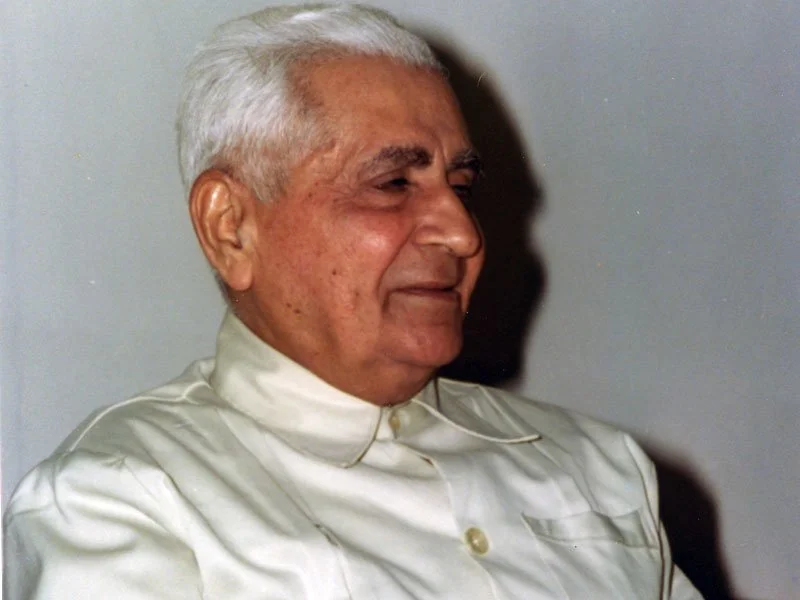
June 11, 1978
by Adi K. Irani
Meher Baba Centre
Ahmednagar (M.S.)
India
TRANSCRIPTION INSTRUCTIONS
A.) Find the BOLDED title below to select and click to open the pdf transcript.
B.) On the right side of this webpage (below for mobile), select and play the talk with the same title.
C.) Read along as you listen to Adi’s talk.
Note: Only BOLDED titles have transcriptions.
2. Living in Baba's Perpetual Presence
3. The 1954 Ahmednagar Darshan
5. The Real Meaning of Meditation
6. The Admednagar Yogi's Peace
7. How Baba Transforms the World
-
Adi opens with prayers and explains that over decades of discipleship, Meher Baba's orders became an instinctive way of life rather than separate rules to follow. To illustrate the difficulty disciples faced, he recounts a private message from Baba stating that those living near him feel his humanity more than his divinity, yet will ultimately realize his divinity.
-
Adi recounts the profound shock when Baba dropped his body in January 1969, remembering Mehera's silent, dazed grief and his own private tears beneath a tree. Emphasizing that the mandali missed Baba's physical presence far more than his words, he shares a guiding message to never think, speak, or act in a way one would hesitate to do in Baba's presence.
-
Adi recounts organizing the massive September 1954 gathering in Ahmednagar, negotiating four months from Baba to alert the district alongside co-workers. When over 100,000 people surged forward at dusk, Baba had to be driven through the crowd seated atop Adi’s Chevrolet so all could receive his darshan.
-
Adi explains that while Indian spiritual seekers easily accept God's omnipresence, recognizing Meher Baba as the Avatar poses a unique hurdle. He resolves this through Baba's distinction between a Perfect Master, a "Man-God" who evolved through creation and the Avatar, "God-Man," who descends directly with supreme universal authority.Adi explains that while Indian spiritual seekers easily accept God's omnipresence, recognizing Meher Baba as the Avatar poses a unique hurdle. He resolves this through Baba's distinction between a Perfect Master, a "Man-God" who evolved through creation and the Avatar, "God-Man," who descends directly with supreme universal authority.
-
Adi redefines meditation, explaining that gathering in fellowship to converse about Meher Baba is far more practical than isolating oneself in a corner. Life with the Avatar offers a unique opportunity where continuous inner remembrance supersedes any formal meditative technique.
-
Baba humorously noted that meditation started when the population was smaller and people had more free time. While it offers temporary peace and strength, it doesn't address deeper life issues or reveal one's divine true self. A yogi in Ahmednagar, who meditated a lot, felt it brought him peace but recognized its impracticality in confusion. Despite this, he valued the peace it provided and continued practicing until he passed away at ninety.
-
Adi explains that Meher Baba's envisioned transformation for the West is a gradual process impacting individuals, families, societies, and the world. He notes that change must occur slowly to avoid suffering and reflects on his experiences promoting Baba's literature, indicating that societal interest evolves over time. While acknowledging the challenges of transformation, Adi emphasizes its necessity for humanity's growth, aiming to minimize suffering during the transition. He illustrates that old structures must be replaced by new ones carefully and gradually to ensure positive changes are manageable for people.
-
A pilgrim inquires about the recognition of Baba's name upon His manifestation, and Adi clarifies that while the name may not be frequently spoken, He will be acknowledged as the Avatar. He shares insights from his recent U.S. tour, highlighting the diverse followers of Meher Baba and the importance of collaboration despite differences. He stresses adherence to Baba's teachings and the necessity of unity in addressing misrepresentations of His message, particularly in Andhra. He warns against dissent that disrupts collective efforts, emphasizing that cooperation is essential for the work that belongs to Meher Baba.
-
Adi explores how Meher Baba uses confusion to deepen concentration and connect individuals to love, contrasting it with the distractions prevalent in meditation. He reflects on love's complexity, noting its misuse and redefinition by Baba, who considers it fundamental to existence. Adi categorizes love by its purity, likening it to water, from divine love as vapor to lust as gutter water, stressing the need to discern among different kinds of love. Ultimately, he conveys that true love exists beyond physical forms or the beloved's presence.
-
The discussion reveals that the Avatar symbolizes the embodiment of God, transcending physical existence. It emphasizes that spiritual connection does not require physical presence, as prayers directed to God are ultimately received by the Avatar, who understands and responds to them. This highlights the difference between God as a conscious entity and the Avatar, who merges divine and human qualities to spiritually uplift humanity. The Avatar serves as a vital link, enabling a deeper connection between God and mankind.
-
Adi explores Avatarhood, noting that for many, it remains a superficial understanding that doesn't touch their hearts. He shares a dialogue with a follower questioning Meher Baba’s designation as an Avatar instead of a saint, highlighting Baba's unwavering commitment to truth over public opinion. Adi reflects on his discomfort with grand titles others applied to Baba and underscores how expectations can lead to frustration. He emphasizes the importance of humility, recounting his personal journey from pride to a profound realization that true closeness to divinity is rooted in servitude and humility rather than status.
-
Following Dr. Ghani's humorous verse offering his sins as a canvas for Baba's generosity, Adi narrates a Judgment Day parable about a sinner who boldly challenges God's mercy over justice. He stresses that divine forgiveness demands genuine conviction rather than superficial imitation.
-
Adi contrasts Kabir's teachings on lust and God with the ultimate truth of divine unity, cautioning disciples against falsely declaring oneness with Baba. He separates Baba's sayings into revelations of His supreme spiritual state versus operational commands, like becoming the dust of His feet.
-
Answering a question on realizing God's personal and impersonal aspects, Adi reflects on the torment of jealousy he experienced over Baba's affection. He recounts an agonizing breakdown in Nasik where Baba patiently allowed him to weep, only to shatter his possessiveness and instantly purify his heart.
-
Describing how he nearly abandoned the New Life in Belgaum due to Baba's cold indifference, Adi K.Irani illustrates how spiritual discrimination (vivek) helps navigate worldly illusion. He explains that realization exposes the world as a dream, showing that surrendering from the heart is our only real way forward.